
14 Facts about February 14 (Valentine’s Day) You Must Know
When you think of Valentine’s Day, you probably picture red roses, heart-shaped chocolate boxes, and maybe a slightly panicked rush to find a gift at the last minute.
But behind all that romance, there are Valentine’s Day facts that are strange, sweet, and sometimes a little dark!
The kind of stories that make you go, “Wait, seriously?”
Have you ever caught yourself wondering, “What are some fun facts about Valentine’s Day that people don’t usually talk about?” Or “Where did all these traditions – the cards, the chocolates, the roses – even come from?”
You are not the only one.
We celebrate it every year, but most of us don’t really know why we do half the things we do on 14 February.
That’s exactly why this guide exists.
Below, you will find interesting facts about Valentine’s Day, from ancient history and old legends to modern spending habits and global traditions. We will also sprinkle in romantic Valentine’s Day facts you can actually use – in conversations on a date, inside your Valentine’s card, or even as fun hooks for your social media posts.
As you read, you might want to ask yourself: Which of these Valentine’s Day facts did I already know? Which ones completely surprise me? And which ones can I steal as cute talking points for this year’s Valentine’s messages?
Think of this as your personal, easy-to-read cheat sheet to the story behind the hearts, flowers, and “Be Mine” messages.
And if all these Valentine’s Day facts inspire you to plan your own celebration, explore our Valentine’s Day flowers and gifts in UAE for romantic surprises delivered across Dubai and beyond.
1. The Real Story Behind Valentine’s Day (It’s Not Just One Person)
Most people think Valentine’s Day is named after one saint, but one of the most surprising Valentine’s Day history facts is that there were actually several early Christian martyrs named Valentine. Historians aren’t even sure which one inspired the day. Two of the best-known are Valentine of Rome, a priest executed around 269 CE, and Valentine of Terni, a bishop martyred a few years later.
Over time, legends blended:
- One story claims that Valentine secretly married couples against the emperor’s orders.
- Another says he healed a jailer’s daughter and signed a note to her “from your Valentine.”
- The Catholic Church eventually became so unsure about the details that it removed St. Valentine from the general calendar in 1969, although the feast can still be celebrated locally.
So, if you have ever felt confused about where Valentine’s Day comes from, you’re not alone – even the Church had questions.

2. A Pagan Festival, A Poet, and How Love Got Involved
One of the most interesting facts about Valentine’s Day is that its timing may overlap with Lupercalia, an ancient Roman festival held in mid-February. Lupercalia was associated with fertility, purification, and the arrival of spring, and included rituals such as animal sacrifices and pairing couples by lottery.
But the actual link between Lupercalia and our modern Valentine’s Day is debated. What we do know is:
- Early Christians celebrated the Feast of Saint Valentine in mid-February.
- Geoffrey Chaucer, a 14th-century English poet, was one of the first to connect Valentine’s Day with romantic love in his poem Parliament of Fowls, which describes birds choosing their mates on “Saint Valentines Day.”
In other words, poetry, timing, and a bit of legend slowly transformed a saint’s feast day into a celebration of romance.

3. The Oldest “Valentine” Was Written in Prison
If you like slightly dramatic Valentine’s Day facts you didn’t know, here’s a good one: the oldest known Valentine message was written in 1415 by Charles, Duke of Orléans, to his wife while he was imprisoned in the Tower of London after the Battle of Agincourt.
A few more Valentine’s Day history facts about early love notes:
- By the 1400s, people were already referring to their partners as “my Valentine.”
- Handwritten love letters and poems slowly evolved into the Valentine’s cards we know today.
- Shakespeare even mentions Valentine’s Day in Hamlet, demonstrating its growing popularity in English culture.
So, yes, if you’re sending a heartfelt message this year, you are continuing a tradition that dates back over 600 years. Pair your message with a beautiful Valentine’s Day bouquet or personalised gift to make it feel even more special.

4. The Woman Who Turned Valentines Into Big Business
One of the lesser-known but interesting facts about Valentine’s Day is that a woman played a significant role in commercializing it. Esther Howland, often referred to as the “Mother of the American Valentine,” began mass-producing elaborate Valentine cards in the mid-1800s in the United States.
Her designs used:
- Lace, ribbons, and layered paper
- Romantic verses and delicate cut-outs
- Imported materials from Europe
These cards caught on so quickly that her business turned Valentine’s Day into a major commercial event. Today, Valentine’s Day is one of the biggest card-sending holidays in the world.
Conversation tip: This is a great romantic Valentine’s Day fact to mention if you’re gifting a card – especially a vintage, lace-style one.
Check out more interesting facts about Women in this blog.

5. Modern Valentine’s Day by the Numbers (Some May Surprise You)
If you like stats, these fun facts about Valentine’s Day show how big the holiday has become:
- Valentine’s Day is consistently one of the top card-sending holidays, second only to Christmas in some countries. (People.com)
- Americans alone are projected to spend tens of billions of dollars on Valentine’s Day each year, with an average spend of around $180+ per person in recent estimates. (Drive Research)
- Approximately 224 million roses are cultivated specifically for Valentine’s Day, with red roses accounting for the majority of orders. (Drive Research). No surprise that Valentine’s Day roses in UAE are always in high demand, especially classic red bouquets and rose combos.
- Beyond red roses, other rose colours are also widely preferred for Valentine’s Day.
- Men usually spend more than four times what women spend on Valentine’s gifts and experiences. (Drive Research)
- And it’s not just couples: billions are spent on gifts for friends, family, teachers, and even pets.
So, the next time you see flower shops and gift sites going all out, remember: the demand is very real.
6. Who Gets the Most Valentine’s Day Cards? (Hint: Not Romantic Partners)
Here’s a Valentine’s Day fact you didn’t know: in some surveys, teachers receive more Valentine’s Day cards than any other group – including spouses and partners. Kids often give cards to classmates and teachers, which adds up quickly. (People.com)
That makes Valentine’s Day not just a romantic holiday, but also:
- A day to appreciate mentors
- A day for children to practice kindness and friendship
- An opportunity for “mini Valentines” at school
It’s a good reminder that Valentine’s Day can encompass a wide range of love – from romantic to platonic and even community-based.

7. Candy Hearts Started as Medicine (Really)
If you have ever eaten those tiny pastel candy hearts with messages on them, you’ll enjoy this fun fact about Valentine’s Day.
The first version of “conversation hearts” traces back to medicinal lozenges in the 1800s. A pharmacist created a machine to press lozenges into easy-to-swallow discs, and that machine was later used to make candy. Eventually, short messages like “Be Mine” or “Kiss Me” were stamped on them, and they became a Valentine’s Day classic. (People.com)
Today:
- Millions of these candies are sold every year.
- New versions even include messages in multiple languages to reflect global love.
- So, the next time you see a candy heart, remember: it started as something your doctor might have given you.

8. Chocolate Boxes Have a Royal & Romantic Backstory
Another interesting fact about Valentine’s Day is tied to chocolate. In the 1860s, the Cadbury family in England created some of the first heart-shaped boxes of chocolates, positioning them as keepsakes that could be used to store letters or trinkets after the chocolates were gone.
Today:
- About 35 million heart-shaped chocolate boxes are sold each year in the U.S. alone. (The Pioneer Woman)
- Chocolate remains one of the most popular Valentine’s gifts worldwide, often paired with roses or soft toys.
If you’re ever stuck for gift ideas, remember this romantic Valentine’s Day fact: a box of chocolates has been a classic expression of love language for over 150 years. For an easy yet romantic surprise, go for Valentine’s Day chocolate gifts with flowers – a timeless combo that works for almost everyone.”
Recommended Blog Read on Valentine’s Day Chocolates:
The Most Loved Luxury Chocolates in Dubai for Valentine’s Day (Top Picks)

9. Valentine’s Day Around the World: Not Always About Couples
If you’re wondering, “What are some fun facts about Valentine’s Day in other countries?” here are a few that will make you see the holiday in a different light. Many cultures have their own twist:
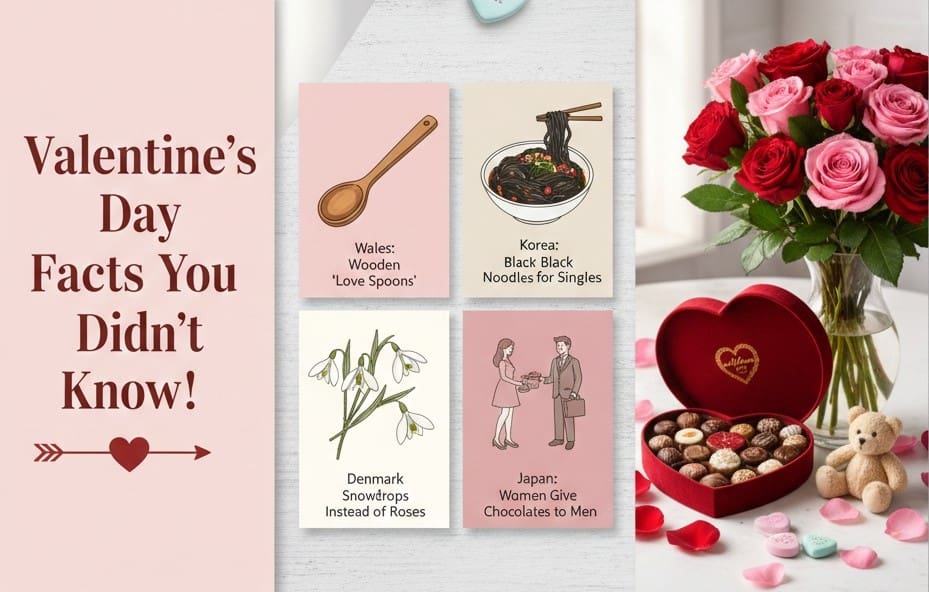
- Japan: Women give chocolates to men on February 14 – not just to partners, but also to colleagues. Men then return the favour a month later on White Day. (Wikipedia)
- South Korea: There’s a “love day” on the 14th of almost every month, including Valentine’s Day and White Day. Singles have their own day on April 14, known as Black Day, when they eat black noodles together. (worldwide.giftbasketsoverseas.com)
- Denmark: Instead of classic roses, people exchange cards and sometimes pressed white flowers, known as snowdrops. (TravelTriangle.com)
- Wales: The traditional gift isn’t chocolate – it’s a hand-carved wooden “love spoon” given as a symbol of affection. (Odysseys Unlimited)
These Valentine’s Day facts show that the holiday isn’t just about couples in fancy restaurants – it can be about friendship, family, and even celebrating single life.

10. Galentine’s Day & Unconventional: Love Beyond Couples
One of the newer fun facts about Valentine’s Day is that it has inspired spin-off celebrations:
- Galentine’s Day (usually on February 13) became popular after a TV show episode and focuses on women celebrating their female friendships. Gift spending on friends has grown massively in recent years. (The Pioneer Woman)
- International Quirkyalone Day (usually on February 14) encourages people to embrace being happily single instead of feeling pressured to be in a relationship. (People.com)
So, if you have ever felt that Valentine’s Day is “not for you” because you’re single, these alternative celebrations are proof that love can be defined on your terms.
11. Pets Are Big Winners on Valentine’s Day Too
Here’s a Valentine’s Day fact you didn’t know: many people now buy Valentine’s gifts for their pets – and total spending on animals runs into the hundreds of millions of dollars each year in some countries. (People.com)
Popular pet Valentine treats include:
- Heart-shaped biscuits
- Special toys
- Matching accessories (like bandanas or collars)
It might sound extra, but for many people, pets are family – and Valentine’s Day is just another excuse to spoil them. If you are that kind of pet parent, you’ll love our cute Valentine’s gifts and hampers with treats, balloons, and teddy shaped flower arrangements.


12. Flowers, Roses, and the Language of Love
No list of romantic Valentine’s Day facts would be complete without flowers. While red roses are the global favourite, many people are unaware that the “language of flowers” (floriography) gained particular popularity during the Victorian era, when individuals used different flowers to convey coded messages. (Encyclopedia Britannica)
A few classic associations:
- Red roses – deep love and passion
- Pink roses – admiration and sweetness-
- White roses – purity and new beginnings
- Mixed bouquets – layered emotions and more personalised meanings
Modern fact: with hundreds of millions of roses grown for the day, Valentine’s is one of the busiest days of the year for florists worldwide, from Europe and the US to the Middle East and Asia. (Drive Research)
If you ever wondered why bouquets get booked out early, this is the reason.
Recommended Blog Read on red roses:

13. Wearing Your Heart on Your Sleeve Was Once Literal
You’ve heard the phrase “wearing your heart on your sleeve,” but one of the most interesting facts about Valentine’s Day is that this was once quite literal.
In some historical Valentine customs, people would draw names from a bowl and pin the name of their “Valentine” on their sleeve, publicly showing who they were matched with or admired. (People.com)
It’s a great example of how Valentine’s traditions have always combined romance, fun, and a touch of drama.
14. How to Use These Valentine’s Day Facts in Real Life
Knowing all these Valentine’s Day facts is fun, but they’re even better when you put them to use. Here’s how:
- In your card: Add one short romantic Valentine’s Day fact (“Did you know the first Valentine we know of was written in 1415 from prison?”) and tie it to your message.
- On social media: Share a carousel of fun facts about Valentine’s Day with cute visuals – perfect for brands, couples, or content creators.
- On a date: Use interesting facts about Valentine’s Day as conversation starters if there’s an awkward pause.
- In classrooms or with kids, turn these facts into a mini-quiz or game so they learn that the holiday is also about friendship and kindness.
- For businesses: Use statistics and historical titbits in newsletters, blog introductions, or product descriptions to make Valentine campaigns more engaging and educational.
Quick Checklist: Valentine’s Day Facts You Can Remember & Reuse
Here’s a simple checklist of Valentine’s Day facts you didn’t know (or maybe just learned) that are easy to remember:
- There were multiple Saint Valentines, and historians still debate who the “real” Valentine’s Day is named after. (Wikipedia)
- The holiday’s timing may overlap with the ancient Roman festival Lupercalia, but the romantic connection came much later, helped by Chaucer’s poetry. (Encyclopedia Britannica)
- The oldest known Valentine message dates back to 1415 and was written from prison. (Wikipedia)
- Esther Howland turned Valentine’s cards into a commercial phenomenon in the 1800s. (Antique Trader)
- Valentine’s Day is one of the biggest card and gift holidays, with billions spent globally, including huge numbers of roses, chocolate boxes, and candy hearts. (Drive Research)
- Many countries celebrate Valentine’s differently – from snowdrop flowers in Denmark to chocolate gifting rules in Japan and Korea. (TravelTriangle.com)
- Valentine’s isn’t just for couples anymore; there are days for friends, singles, and even pets. (People.com)
Final Thoughts
Valentine’s Day might look simple on the surface – flowers, chocolates, hearts – but once you dig into these interesting facts about Valentine’s Day, you realise it’s a holiday built from history, poetry, clever marketing, and all kinds of love.
So, whether you are planning a romantic evening, a Galentine’s get-together, or just a cosy night with your pet and a box of chocolates, adding thoughtful Valentine flowers and gifts can make the moment feel extra special. With these Valentine’s Day facts, stories, and conversation starters, February 14 can feel a little more personal — and a lot more memorable.
FAQs | Valentine’s Day Facts You Probably Didn’t Know
We celebrate Valentine’s Day on February 14 because it is linked to the feast of Saint Valentine, an early Christian martyr. Over time, poets and writers connected this date with romance, and it slowly became a day to celebrate love.
Some fun facts about Valentine’s Day are that teachers get a lot of cards, millions of roses are sold every year, and people even buy gifts for pets.
Red roses are popular on Valentine’s Day because they symbolise deep love and passion. Over the years, they became the classic “love flower,” so many people choose red rose bouquets to express romantic feelings on February 14.
No, Valentine’s Day is not only for couples. Many people use the day to celebrate friends, family, children, teachers, and even pets. It’s really about showing love and appreciation, in whatever form matters most to you.