
BlackTulipFlowers.Com
Flower Care Guide: Expert Tips to Keep Every Flower Fresh Longer
Learn simple care tips for roses, lilies, tulips, hydrangeas, orchids, sunflowers, and more, with easy steps from bringing them home and unwrapping to vase maintenance.
Whether you’ve received a bouquet as a gift or ordered flowers for your home, proper flower care can significantly extend their freshness and beauty. With the right care, most bouquets can last between 4-7 days, while some varieties, such as orchids and carnations, can remain fresh even longer.
How to Keep Flowers Fresh Longer: Quick Answer
To keep fresh flowers looking their best for longer, unwrap the bouquet, remove any leaves below the waterline, trim each stem at a 45° angle, and place the flowers in a clean vase filled with fresh water and flower food. Keep the arrangement away from direct sunlight, heat, and ripening fruit. Change the water every 2–3 days and re-cut the stems each time to help the flowers stay fresh.
Universal Rules (Apply to Every Bouquet)
These habits extend the vase life of almost any fresh-cut flower.
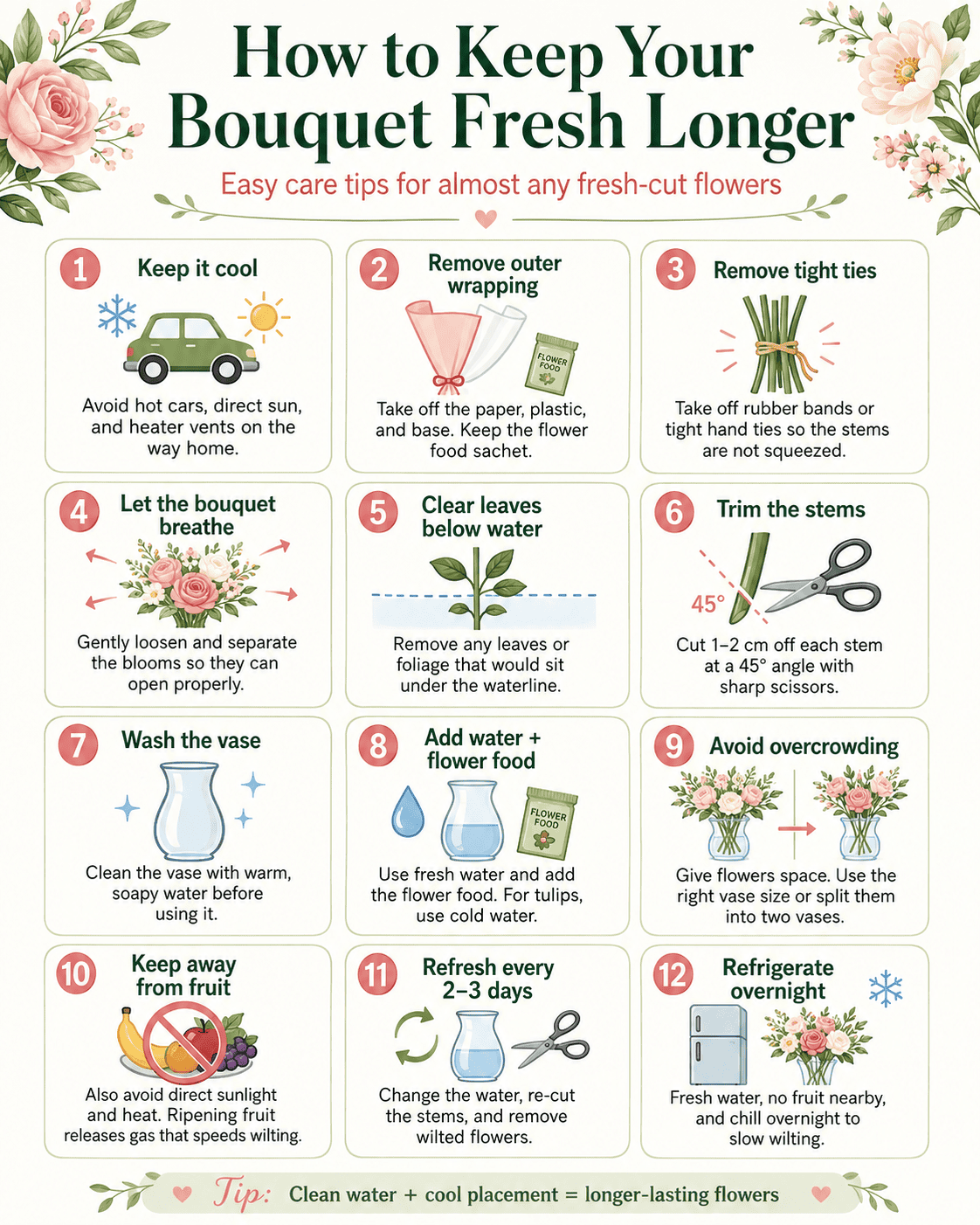
- Keep it cool on the way home. Avoid leaving the bouquet in a hot car, direct sunlight, or next to a heater vent, even for a short time. Heat can cause flowers to wilt before they even reach a vase.
- Remove all outer wrapping. Take off any wrapping and base completely. Keep the flower food sachet aside; you’ll need it later.
- Handle the inner tie carefully. If the stems are tightly hand-tied or simply held together with a rubber band, remove it straight away.
- Let the bouquet breathe. Gently separate the blooms by hand so they aren’t pressed tightly together. This gives each flower enough space to open fully over the next few days.
- Separate and check each stem. Gently spread the stems apart and remove any leaves or foliage that will sit below the waterline. Leaves left in the water rot quickly and can make the water cloudy.
- Cut every stem. Trim 1–2 cm off each stem at a 45° angle using sharp scissors or florist snips, even if the flowers were freshly cut. This removes the dried stem ends, increases the surface area for water uptake, and prevents the stem from sealing flat against the base of the vase. Roses and other bubble-prone stems benefit from being cut under water.
- Prepare the vase. Wash your vase with warm, soapy water before using it. Leftover residue can encourage bacteria to grow, which clogs the stems and causes the water to become cloudy more quickly.
- Fill the vase and feed. Use a clean vase and fill it with room-temperature water. Add the provided flower food before placing the flowers in the vase. For tulips, use cold water instead. Place the stems in the water promptly so they don’t dry out.
- Avoid overcrowding. Ensure flowers have enough space in the vase to breathe. Overcrowding can restrict airflow and cause wilting. So, use the right vase size or split flowers into two vases.
- Keep it cool and away from fruit. Place your flowers away from direct sunlight, heating vents, and ripening fruit. Fruit releases a natural ethylene gas that can make flowers wilt more quickly. Carnations, lilies, tulips, and delphiniums are especially sensitive to it.
- Refresh. Change the water every 2–3 days, re-cutting the stems each time. If any flowers begin to wilt, remove them to prevent them from affecting the rest of the arrangement.
- Refrigerate overnight. It slows down metabolism, which prevents wilting and stops them from blooming too quickly. Before placing it in the fridge, ensure flowers are in fresh water, and there is no fruit nearby.
Care Instructions by Flower Group
This guide offers care tips for the flowers we deliver most often — grouped by how they need to be cared for, so you can find the right steps quickly no matter what’s in your bouquet.
Note: Vase life is counted from the day a flower is cut, not the day it arrives. Freshly sourced flowers will typically last toward the longer end of the ranges below.

Roses, Carnations & Chrysanthemums: Long-Lasting Classics
These three flowers are the foundation of many mixed bouquets. They are sturdy, easy to care for, and among the longest-lasting cut flowers available.
Care Steps
- Re-cut 2–3 cm off each stem at a 45° angle every 2–3 days. For roses, trim the stem while holding the cut end underwater to help prevent air bubbles from blocking water absorption.
- Remove any leaves or foliage below the waterline straight away. This is one of the most common causes of cloudy water in mixed bouquets.
- For carnations, trim just above a stem node (the slightly swollen ring on the stem). This helps the flower absorb water more efficiently.
- If your roses arrive looking droopy, trim about an inch off the stems and submerge the entire stem in a sink of water for 20–60 minutes before placing them back in the vase.
- Change the water every 2–3 days. While all three flowers are relatively easy to care for, they stay fresher for longer with regular water changes.
Expected Vase Life
10–21 days. These are among the longest-lasting cut flowers, with carnations being especially well known for their exceptional vase life.

Lilies, & Alstroemeria: Succession Bloomers
These flowers produce multiple buds on a single stem that bloom one after another over several days. With a little ongoing care, they can stay fresh and beautiful for longer.
Care Steps
- Remove each bloom as it fades instead of waiting for the entire stem to finish flowering. This helps direct the plant’s energy to the unopened buds and keeps the arrangement looking fresh.
- For lilies, gently remove the orange anthers before they fully open. This helps prevent pollen stains on petals, clothing, and furniture, while also slightly extending the life of the blooms.
- Re-cut the stems at a 45° angle every 2–3 days when changing the water. Lilies, alstroemeria, and gladioli can all be safely arranged with roses, carnations, and chrysanthemums without any sap-related issues.
Expected Vase Life
7–14 days. Fresh blooms will continue to open throughout much of this period, helping the arrangement stay fresh and beautiful for longer.
Tulips: True Bulb Flowers
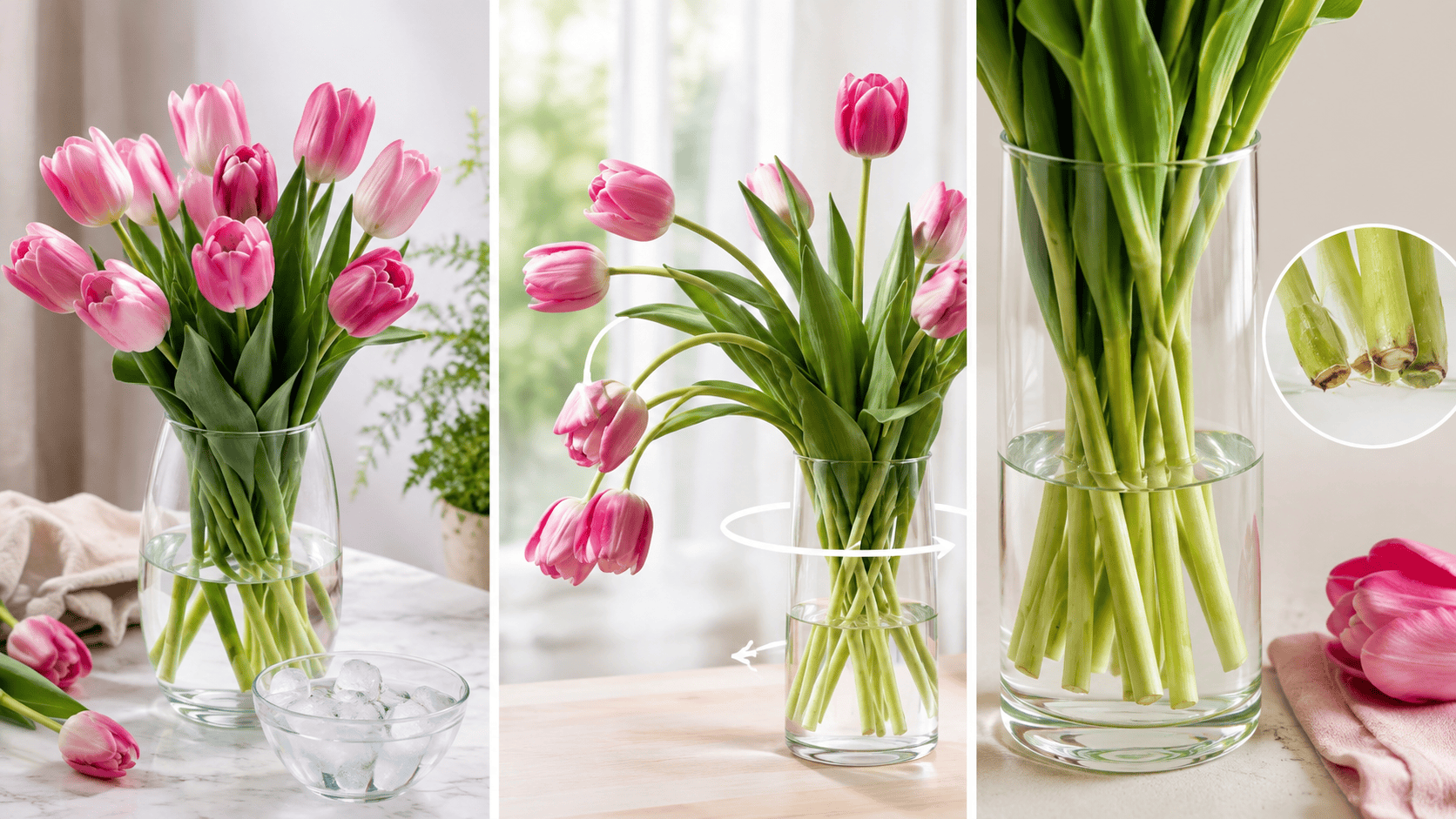
These bulb flowers need slightly different care. Daffodils and hyacinths release sap when cut, while tulips are generally safe to mix with other flowers but prefer cooler water and may continue to grow after being arranged.
Care Steps
- Use cold water for tulips. They hold their shape better in cooler water and are more sensitive to warmth than daffodils or hyacinths.
- Tulips may continue to grow by 1–2 cm after being arranged and naturally bend towards the light. This is completely normal. Rotate the vase every day or two to help keep the arrangement even.
- Fill the vase only partway with water. Deep water can encourage stem rot in bulb flowers more quickly than in woody or fibrous stems.
Expected Vase Life
5–10 days. Among the popular bulb flowers, tulips often last a little longer when kept cool and well hydrated.

Sunflowers & Gerberas — Daisy-Family Single Blooms
Both flowers have a large, heavy bloom on a relatively soft stem, so keeping them well-hydrated and properly supported helps them stay fresh for longer.
Care Steps
- Use a heavy, wide-based vase for sunflowers. Their large blooms can make lightweight vases tip over.
- Keep gerbera stems as straight as possible, as they tend to bend. A support collar, floral wire, or a narrow-necked vase can help keep them upright.
- Both flowers absorb a lot of water. Check the water level daily, top it up as needed, and replace it every 2–3 days. Re-cut the stems at a 45° angle each time.
- Remove any lower leaves from sunflower stems, as they decay quickly and can make the water cloudy.
- Keep both flowers away from direct sunlight indoors. Although sunflowers thrive in the sun when growing, direct sunlight can shorten the vase life of cut blooms.
Expected Vase Life
6–10 days.

Hydrangeas: Woody Stem Flowers
Hydrangeas are especially thirsty and respond well to a specific revival method, so they have their own care instructions.
Care Steps
- Split or lightly crush the last inch of the woody stem before placing it in water. This exposes more surface area and helps the flower absorb water more effectively.
- If the blooms start to look wilted or the edges become crisp, re-cut the stem and fully submerge both the stem and flower head in cool water for a few hours or overnight. This helps rehydrate the blooms.
- Check the water level every day. Hydrangeas absorb more water than most flowers, and letting the vase run dry can quickly shorten their vase life.
- Change the water every 2–3 days and re-cut the stems at a 45° angle, just as you would with other fresh flowers.
Expected Vase Life
5–10 days. Their vase life can be extended noticeably by using the full-submersion revival method when needed.

Peonies: Soft Multi-Petal Seasonal Blooms
Peonies have their own care requirements, with the focus on helping the buds open properly rather than managing water temperature or sap.
Care Steps
- If the buds are still tightly closed and firm, keep the stems at room temperature (not in the fridge) until the buds feel slightly soft, like a marshmallow. This may take a day or two and helps the flowers open evenly instead of staying closed.
- Once the buds begin to soften and show colour, move the arrangement to a cooler spot. This slows the blooming process and helps the flowers last longer.
- Handle the petals gently when arranging them, as peonies bruise more easily than most other flowers.
- Re-cut the stems at a 45° angle every 2 days and change the water at the same time. Peonies are not bulb flowers, so they don’t need to be kept separate from other blooms.
Expected Vase Life
5–7 days once fully open. They may last for a shorter time if kept in a warm room
Orchids (Phalaenopsis & Cymbidium): Tropical Blooms with Aerial Roots
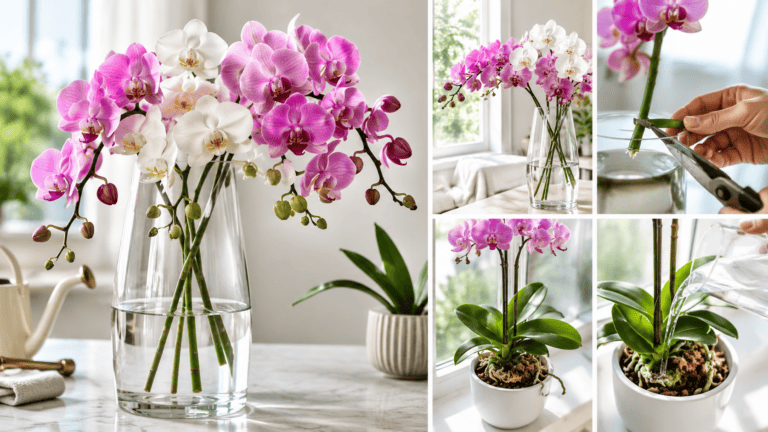
Cut orchid sprays are more sensitive to their environment than to water quality, and they need different care from a potted phalaenopsis orchid.
Care Steps
- Use filtered or distilled water whenever possible, as orchids are sensitive to chlorine and hard water.
- Keep the arrangement at a stable room temperature (18–23°C). Avoid placing it near drafts, air-conditioning vents, or areas with sudden temperature changes, as these can cause the buds to drop early.
- Place the orchids in bright, indirect light. Avoid direct sunlight, which can quickly scorch the delicate petals.
- Re-cut the stem ends every few days and change the water every 2–3 days, just as you would for other cut flowers.
- If you’re caring for a potted orchid instead of cut sprays, water it only when the growing medium feels dry to the touch (usually about once a week). Never let the roots sit in standing water.
Expected Vase Life
10–14 days for cut orchid sprays. With proper light and watering, potted orchids can rebloom for months.
Sap-Producing Flowers to Isolate First
Some flowers like hyacinths and daffodils release a milky sap when cut that can clog their own stem and need a little extra care before being added to a mixed bouquet.
Poppies and euphorbia release a milky sap that can clog their stems and may irritate the skin. Briefly sealing the freshly cut stem end in a flame or dipping it in hot water for 15–20 seconds helps keep the water channels open without damaging the bloom.
As a general rule, if a flower stem releases visible sap or a milky liquid when cut, place it in a separate container of water for a few hours before mixing it with other flowers. This applies even to flowers that aren’t specifically covered in this guide.

Caring for Mixed Bouquets
Most bouquets contain flowers from different care groups. Following these extra care tips will help all the flowers last longer, instead of having some fade much sooner than others.
- Use lukewarm water to start. Bulb flowers like Tulips prefer cold water, while roses, hydrangeas, and sunflowers do better in warm water. If they’re all in the same vase, lukewarm water is the best compromise and works well for a mixed bouquet.
- Check each stem before arranging. A weak or damaged stem can affect the water quality for the entire bouquet. Take a moment to inspect each stem as you unwrap the flowers instead of assuming they’re all in the same condition.
- Condition sap-producing flowers first. If your bouquet includes daffodils or hyacinths, place them in their own container of water for a few hours before mixing them with roses, lilies, or other flowers. Their freshly cut stems release sap that can shorten the life of nearby blooms.
- Don’t overfill the vase. Different flowers need different water levels. Smooth-stemmed flowers like roses and tulips generally take up more water, while rough or hairy-stemmed flowers like sunflowers and gerberas can be more prone to stem rot if the water is too deep. A moderate water level works best for mixed bouquets.
- Don’t worry if some flowers fade first. This is completely normal. In bouquets that combine long-lasting flowers like roses, carnations, and chrysanthemums with shorter-lasting flowers like peonies and hydrangeas, the shorter-lived blooms will naturally fade first. Simply remove them as they wilt, and the remaining flowers will often stay fresh for several more days.
Flower Care for Floral Foam Arrangements
Flower boxes, baskets, floral teddies, heart-shaped arrangements, and many custom designs are made using floral foam instead of being arranged in a vase. These require slightly different care, as it’s the foam, not open water, that needs to stay hydrated. The flower-specific care tips above still apply to each stem, but the following steps are specific to floral foam arrangements.
Care Steps
- Do not remove the flowers from the foam. The stems are cut to the correct length and placed to draw water directly from the foam. Removing them to rearrange or place them in a vase can interrupt the water supply and shorten their vase life.
- Add a small amount of fresh water to the foam every day. A daily top-up, even a small one, helps keep the foam moist. Don’t wait until it looks dry.
- Keep the foam consistently moist, not soaking wet. Gently press a finger into an exposed area of the foam. If it feels dry or no water comes to the surface, it’s time to add more water.
- Water the foam, not the flowers. Pour the water slowly into an open corner of the foam or along the edge of the container. Avoid pouring water directly onto the blooms or foliage, as this can encourage mould and speed up spoilage.
- Use a small watering can, jug, or bulb syringe. This gives you better control and helps prevent water from splashing onto the flowers.
- Keep the arrangement indoors, away from direct sunlight and heat. Floral foam dries out faster than a vase of water, so warm rooms, sunny windows, and outdoor areas can shorten the life of the arrangement.
- Remove faded or wilting flowers promptly. Cut them at the surface of the foam rather than pulling them out. This helps avoid damaging the foam and prevents air pockets that can stop nearby stems from absorbing water.
Expected Vase Life
With daily watering, floral foam arrangements can stay fresh for several days and may last almost as long as the flowers would in a vase. The key is to keep the foam consistently moist and never let it dry out.
Common Flower Care Mistakes to Avoid
Most flowers don’t fade early because they’re difficult to care for. In most cases, it’s caused by a few common mistakes that are easy to avoid.
- Using a dirty or previously used vase. Even after a quick rinse, leftover residue and bacteria can remain and contaminate fresh water. Always wash the vase thoroughly with warm, soapy water before use.
- Overfilling or underfilling the vase. Too little water can leave the stems dry between top-ups, while too much water can submerge the leaves and encourage stem rot in some flowers. Fill the vase with enough water to cover the cut stems without leaving any foliage underwater.
- Cutting the stems straight across. A flat 90° cut can rest against the bottom of the vase and reduce water absorption. Always trim the stems at a 45° angle.
- Leaving leaves below the waterline. Submerged leaves rot quickly, causing cloudy, smelly water and encouraging bacteria that block the stems.
- Skipping water changes. Even with flower food, bacteria build up over time. Change the water every 2–3 days and re-cut the stems each time to keep your flowers fresh.
- Placing flowers near ripening fruit. Fruit releases a natural gas that speeds up wilting. Carnations, lilies, tulips, and delphiniums are especially sensitive to it.
- Keeping flowers in direct sunlight or near heat and air-conditioning vents. Heat and constant airflow can dry out the flowers and significantly shorten their vase life.
- Mixing daffodils or hyacinths into a bouquet without conditioning them first. Their freshly cut stems release sap that can shorten the life of other flowers sharing the same water.
- Using a metal vase or container. Metal can react with the water and flower food, reducing its effectiveness. Glass, ceramic, or plastic containers are a better choice.
- Overcrowding the vase or floral foam. Packing too many stems into a small space restricts air circulation and increases competition for water, causing the flowers to fade more quickly.
How to Revive a Wilting Bouquet/Flowers
If your bouquet starts looking tired sooner than expected, don’t worry, it can often be revived. Wilting is usually caused by blocked stems, bacteria in the water, or dehydration from heat, and in most cases, these problems can be fixed.
- Remove anything beyond saving first. Cut away any fully dead or badly wilted flowers and foliage. This allows the healthier stems to absorb more water and nutrients.
- Re-cut every stem. Trim at least 2–3 cm off each stem at a 45° angle. The cut ends may have dried out or become blocked, so a fresh cut helps the flowers absorb water again.
- Use lukewarm water for the revival soak. Lukewarm water is absorbed more quickly than cold water, helping rehydrate the flowers faster. Even flowers that usually prefer cool water, like tulips, benefit from lukewarm water during the initial revival.
- Give badly wilted flowers a full soak. Submerge the stems in a bucket or sink of lukewarm water for 20–30 minutes. If needed, wrap the bouquet in paper first to help keep it together. This works especially well for flowers that have become dehydrated.
- Clean the vase before putting the flowers back. If the water was cloudy, wash the vase thoroughly with warm, soapy water before refilling it with fresh water. Putting revived flowers back into dirty water will quickly undo your efforts.
Some flowers also respond well to these extra care tips:
- Hydrangeas: Submerge the entire flower head in cool water for about 30 minutes.
- Roses: Add a teaspoon of sugar to the vase water to give them an extra energy boost.
- Delicate flowers like lilies: Lightly mist the blooms with water during hot, dry weather.
- Give the flowers time. A revived bouquet may not recover immediately. Most flowers need a few hours after re-cutting and rehydrating before you notice a visible improvement.
Frequently Asked Questions
Change the water every 2–3 days and re-cut the stems at a 45° angle each time. If the water becomes cloudy or starts to smell before then, replace it straight away.
Tap water is suitable for most flowers. However, delicate flowers like orchid sprays do better with filtered or distilled water because they’re more sensitive to chlorine and hard water.
A cool room is usually all you need. Household fridges are often colder than ideal and usually contain fruit, which releases ethylene gas that can make flowers age faster. It’s better to keep your flowers away from direct sunlight and heat.
Yes. Flower food helps feed the flowers and slows the growth of bacteria in the water, helping them last longer. If you’ve misplaced the packet, a teaspoon of sugar can provide some nourishment, but it won’t keep the water as clean as proper flower food.
This is usually caused by a blocked stem rather than a lack of water. Air bubbles, bacteria, or a dried stem end can stop the flower from absorbing water properly. Re-cut the stem at a 45° angle and place it back into fresh water.
Yes. Tulips and roses can usually be arranged together. However, daffodils and hyacinths should be placed in clean water on their own for a few hours before mixing them with other flowers, as their freshly cut stems release sap that can shorten the life of nearby blooms.
This is completely normal. Tulips continue to grow after they’re cut and naturally bend towards the light. Rotate the vase every day or two to keep the arrangement even. Using cold water can also help slow this movement.
It’s optional. Removing thorns is mainly for safety and appearance, as they don’t affect how long the flowers last. If you do remove them, use a knife or thorn stripper carefully to avoid damaging the stem.
Start with a clean vase, trim the stems at a 45° angle, remove any leaves below the waterline, use flower food, change the water every 2–3 days, and keep the flowers away from heat, direct sunlight, and ripening fruit.
Yes. Remove the outer wrapping before placing the flowers in a vase. If the bouquet is hand-tied to keep its shape, you can leave the tie on while placing it in the vase and loosen it once the stems are settled in the water.
Leave the flowers in the floral foam and add a small amount of fresh water directly to the foam every day. Keep the arrangement away from heat and remove wilted flowers by cutting them at the surface of the foam.
Quick Reference: Vase Life by Flower Group
| Flower Group | Typical Vase Life | Key Watch-Out |
| Roses, Carnations & Chrysanthemums | 10–21 days | Roses are prone to air bubbles in the stems. Otherwise, these flowers are very easy to care for. |
| Lilies & Alstroemeria | 7–14 days | Remove faded blooms as new buds continue to open along the stem. |
| Tulips | 5–10 days | Daffodils and hyacinths release sap, so condition them before mixing. Tulips prefer cold water. |
| Sunflowers & Gerberas | 6–10 days | Their heavy blooms need good support and regular watering. |
| Hydrangeas | 5–10 days | Very thirsty flowers. Revive them by soaking both the flower head and stem in water. |
| Peonies | 5–7 days | Not a bulb flower. Let the buds soften at room temperature before they fully open. |
| Orchids (Cymbidium, Phalaenopsis)) | 10–14 days (cut sprays) | Sensitive to chlorine, sudden temperature changes, and direct sunlight. |